Cardano Founder Reveals Leios Solves The Blockchain Trilemma

bitcoinistPublished on 2026-02-10Last updated on 2026-02-10

Abstract

Cardano is developing a major layer-1 upgrade called Ouroboros Leios, aimed at significantly increasing the network's throughput from the current 10–15 transactions per second (TPS) to around 500 TPS initially, with a long-term goal of reaching 10,000 TPS. The upgrade, targeted for release in 2026, is designed to enhance scalability while maintaining decentralization and security—addressing the blockchain trilemma. Cardano founder Charles Hoskinson emphasized that Leios is the result of a decade of research and collaboration among numerous scientists and engineers. The protocol introduces a new block type called "endorser blocks" to bundle more transactions efficiently. Additionally, the upgrade is engineered to fail safely back to the current Ouroboros Praos consensus if needed. The development team plans a gradual rollout to avoid overburdening stake pool operators (SPOs), with a public testnet expected by the end of Q2 2026. Hoskinson also highlighted Cardano’s on-chain governance and treasury as key long-term advantages for funding future upgrades.

Cardano is preparing a layer-1 upgrade it says will push mainnet throughput from roughly 10–15 transactions per second to hundreds, while keeping the network’s decentralization and security profile intact. At a Tokyo community event on the Midnight Japan Tour, Input Output’s Michael Smolenski and Cardano founder Charles Hoskinson framed Ouroboros Leios as both a scaling step and a broader consensus breakthrough.

Smolenski, Cardano Core product manager at Input Output, told attendees Leios is “an upgrade to layer 1 to make Cardano faster,” with active development underway and a target release “this year in 2026.” He described the current throughput ceiling as suitable for proving out Ouroboros’ design, but insufficient for the next phase of adoption and for the economics of stake pool operators (SPOs).

Cardano’s Leios Eyes 50x Speed Boost In 2026

“Up until now the speed of the network has been around [...] 10 to 15 transactions per second,” Smolenski said. “But now we need to move on to higher transaction throughput in order to compete and drive further adoption. Another factor, SPOs, they in the long term need to support the cost of their operations from transaction fees instead of from block rewards [...] they need to see network usage of around 50 transactions per second.”

The initial Leios mainnet release is pitched as a “50 times improvement,” with Smolenski translating that into an early move from roughly 10 TPS to around 500 TPS. Rather than sticking to transactions-per-second as the headline metric, he emphasized “transaction kilobytes per second” to account for varied transaction sizes, calling out a target of “300 transaction kilobytes per second” and a confirmation window “between 20 to 80 seconds,” based on prototype results.

Smolenski described Leios as Cardano’s “next generation consensus protocol,” built around additional block types. “There’s a new block. It’s called an endorser block,” he said, adding that existing blocks would be referred to as “ranking blocks.” The practical consequence, in his telling, is the ability to “pack a whole lot more transactions” by bundling them into endorser blocks, alongside other prioritization mechanics he did not detail on stage.

He also stressed that scaling will be incremental to avoid overburdening node operators. The team plans to demonstrate higher throughput in steps, first targeting 500 TPS on mainnet, then proving 1,000 TPS in the near term, with an eventual ambition of 10,000 TPS. “We can’t just go from where we are [...] and go up to 10,000 transactions per second because this needs to be done in a strategic manner,” Smolenski said, repeatedly pointing to the need to “bring the SPOs along with us.”

On timeline, he said a first public Leios testnet is targeted “at the end of Q2 this year,” ahead of a mainnet hard fork.

Hoskinson: ‘Not Just TPS’ But The Trilemma

Hoskinson widened the frame, positioning Leios as the culmination of a decade-long research and engineering pipeline. “Ouroboros Leios didn’t begin in 2026 [...] Leios actually began in 2016, 10 years ago,” he said, describing “more than two dozen papers,” “dozens of protocols,” and contributions spanning “more than 15 engineering firms” and “168 scientists over a 10-year period.”

“Why Leios is special is it’s not TPS,” Hoskinson said. “It’s actually a resolution of the hardest problem in consensus and blockchain, the blockchain trilemma [...] you have decentralization, you have security, and you have scalability [...] we’re told you can only pick two.” He then made the core claim: “This protocol is decentralized, secure, and fast.”

Notably, Ethereum co-founder Vitalik Buterin also said the blockchain trilemma has effectively been solved, comments he made just a few weeks ago.

Hoskinson also argued the design is engineered to degrade safely. “If the protocol fails, the protocol fails to what we have today. It collapses to Ouroboros Praos,” he said, referencing a prior network incident he characterized as a soft fork in which “Cardano split into two networks” and later “came back together by itself.”

In the same remarks, Hoskinson repeatedly returned to governance capacity as the longer-horizon advantage, suggesting pure technical differentiation is transient. He pointed to Cardano’s on-chain governance and treasury — “a billion dollars in it [...] that you control [...] the ADA holders,” he said — as the mechanism to fund upgrades and coordinate change over time.

At press time, ADA traded at $0.2638.
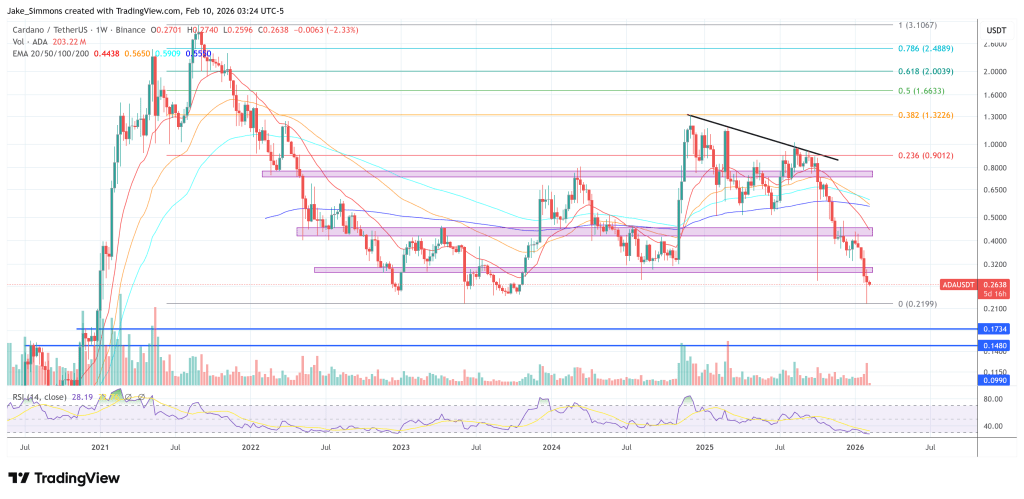
ADA hovers above key support, 1-week chart | Source: ADAUSDT on TradingView.com

Related Questions

QWhat is the main goal of the Cardano Leios upgrade and when is it targeted for release?

AThe main goal of the Cardano Leios upgrade is to significantly increase the mainnet throughput from 10-15 transactions per second to hundreds, while maintaining decentralization and security. It is targeted for release in 2026.

QAccording to Michael Smolenski, what are the two key reasons Cardano needs higher transaction throughput?

AAccording to Michael Smolenski, Cardano needs higher transaction throughput to compete and drive further adoption, and to allow stake pool operators (SPOs) to support their operational costs from transaction fees, which requires a network usage of around 50 TPS.

QHow does Charles Hoskinson position the significance of Ouroboros Leios beyond just transaction speed?

ACharles Hoskinson positions Ouroboros Leios as a resolution to the blockchain trilemma, claiming it achieves decentralization, security, and scalability simultaneously, which is considered the hardest problem in consensus and blockchain.

QWhat is the safety mechanism described for the Leios protocol if it fails?

AIf the Leios protocol fails, it is engineered to degrade safely by collapsing back to the previous Ouroboros Praos protocol, as demonstrated in a past network incident where Cardano split and then recovered by itself.

QWhat longer-term advantage does Hoskinson suggest is more important than pure technical differentiation for Cardano?

AHoskinson suggests that Cardano's on-chain governance and treasury, controlled by ADA holders and containing about a billion dollars, is the longer-term advantage as it provides the mechanism to fund future upgrades and coordinate change.

Related Reads

Stop Saying ‘We Need Privacy’

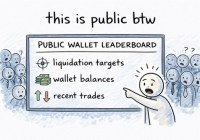
Title: Stop Saying ‘We Need Privacy’ The article argues that "privacy" is not a single concept but rather five distinct problems in the context of blockchain and cryptocurrency. When people demand privacy, they are often referring to one of the following: 1. **Intent Privacy:** Hiding transaction details from observers before execution to prevent front-running by MEV bots. Solutions include private transaction delivery (e.g., Flashbots Protect) and encrypted mempools (e.g., Shutter Network). 2. **Value Privacy:** Concealing the amounts transferred. This is achieved through shielded systems (e.g., Zcash, Penumbra) that use cryptographic proofs to verify transactions without revealing values. Privacy can still be compromised by user behavior patterns. 3. **Graph Privacy:** Protecting the relationships and patterns of who transacts with whom. Techniques include pooled unlinkability (e.g., Tornado Cash mixers) and stealth addresses (e.g., ERC-5564) to break direct on-chain links between transactions. 4. **State Privacy:** Keeping DeFi positions, balances, and liquidation thresholds hidden. This requires storing state as private records and using zero-knowledge proofs (ZK-proofs) to validate state changes without revealing underlying data (e.g., Aztec). Composability and edge interactions remain challenges. 5. **Execution Privacy:** Hiding the computation logic itself, crucial for strategies like auctions or liquidations. Methods include using Trusted Execution Environments (TEEs) (e.g., Secret Network) or ZK-proofs for private execution. The article concludes that privacy often fails at the edges, such as at the RPC (Remote Procedure Call) layer, where providers can collect IP addresses and wallet information. The key is to ask which surface is being protected and where information might leak when users interact with the real world, rather than seeking a single winning privacy model.

比推15m ago

Stop Saying ‘We Need Privacy’

比推15m ago

Trading

Spot
Futures

Hot Articles

Discussions

Welcome to the HTX Community. Here, you can stay informed about the latest platform developments and gain access to professional market insights. Users' opinions on the price of ADA (ADA) are presented below.

活动图片